Why Manufacturing Is No Longer Deterministic
When the same event can mean completely different things depending on context — and why that changes everything about how we design manufacturing systems.
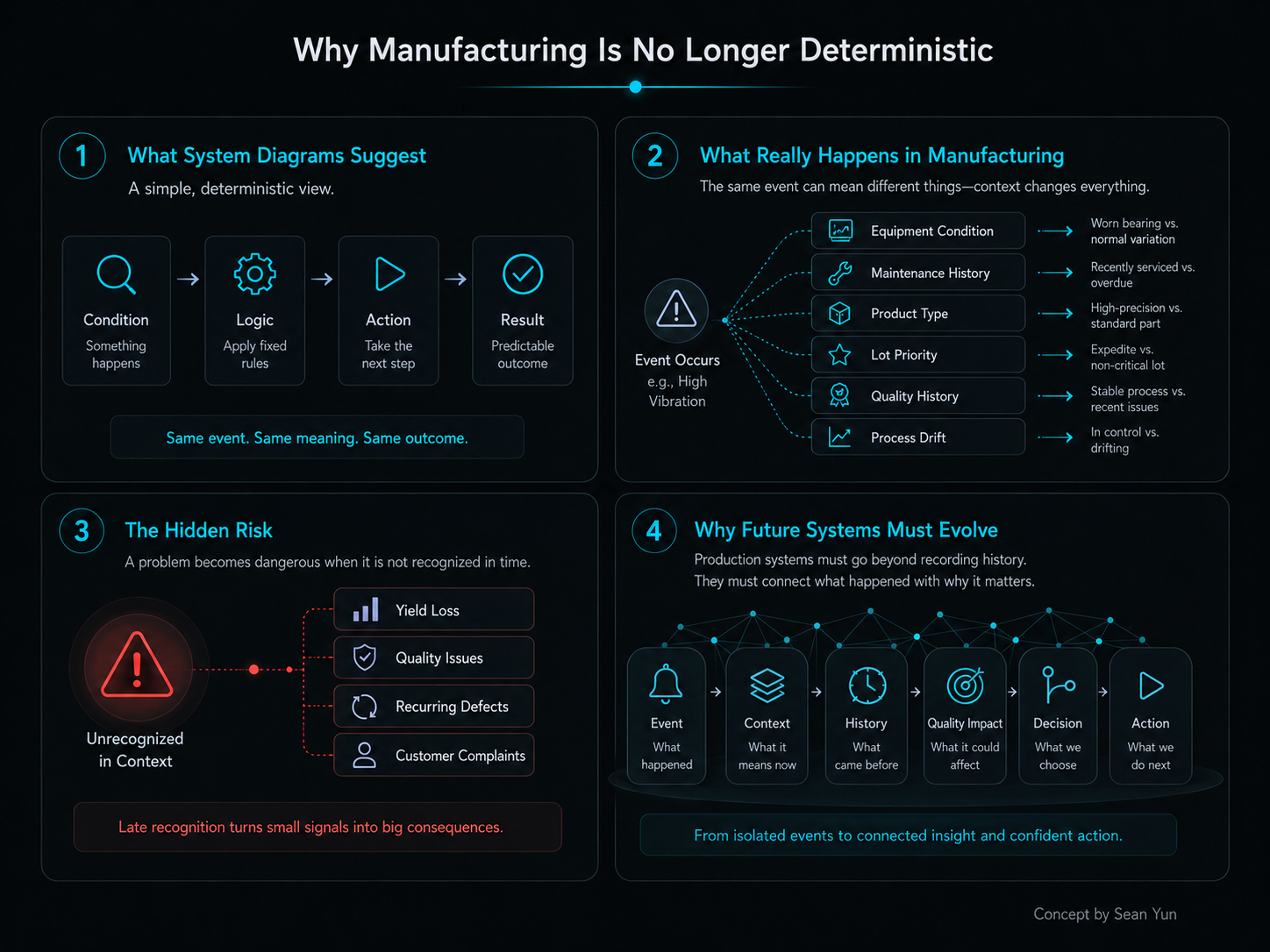
The Clean Diagram Problem
When we design manufacturing systems, we tend to define the flow as if it were fully predictable.
There's a process sequence. There are equipment actions. There are inspection criteria. And there are rules for handling exceptions.
On system diagrams, everything looks clean and logical. When a condition is met, predefined logic runs, and the expected result seems to follow.
But real manufacturing operations are far more complex.
Context Changes Everything
Even when the same event occurs, its meaning isn't always the same.
Take a simple example: the same alarm can mean very different things depending on context.
- What's the current equipment condition?
- Did it occur right after maintenance?
- Does it repeat only for a specific product type?
- What is the lot's quality history?
- Is the lot running under high priority?
- Is it correlated with process drift?
With that context, the judgment — and the response — can change entirely.
The Recognition Problem
Here's the more important point.
Even when something goes wrong, it only becomes a "problem" once we recognize it as one.
If we don't recognize it, it can pass as just another event in the moment. Later, it can return as a much bigger issue — a quality escape, yield loss, customer complaint, or recurring defect.
Or it gets treated as a one-off without root-cause understanding — and quietly fades from organizational memory.
Standardization Still Matters
To be clear: standardization is still critical in manufacturing.
We need rules. We need defined workflows. We need clear standards and procedures.
But day-to-day operations can't be explained by a simple "condition → action → result" chain.
The shop floor is full of variables:
- Equipment health changes
- Process states drift
- Product mix shifts
- Operational priorities keep moving
The Limits of MES Today
As a core production system, MES captures essential history: lot movement, operation execution, equipment usage, hold/release, and track-in/track-out.
But whether a specific event truly affected quality is often discovered later — through quality systems, analytics, SPC/FDC, inspection results, or engineers' post-analysis.
In that loop, MES largely supports by answering one question: "What happened?"
But it's still limited when it comes to understanding:
- Why did it matter?
- How could it affect quality?
- What future risk might it create?
The Question That Matters
That leads to a question I think matters:
Should future production systems remain systems of record — focused on capturing and serving history?
Or should they evolve to connect production events with quality impact, equipment conditions, process context, and operational decisions?
Future systems may need to help teams recognize issues earlier, support root-cause analysis, and surface risks before they grow.
In many cases, a problem becomes dangerous not when it happens, but when it passes unnoticed.
What AI-Native Means Here
That's why I believe manufacturing systems must evolve beyond simple transaction processing.
They need to become context-aware operational systems that connect:
- Event
- Context
- History
- Quality impact
- Decision
- Action
An AI-native manufacturing system isn't just a system where AI generates answers. It's an architecture that understands shop-floor events in context, links production history to quality impact, and flags emerging issues before they're labeled as problems.
This is Part 2 of the AI-Native Manufacturing Architecture Series — a 12-part exploration of how manufacturing systems need to fundamentally change.