The Rule Explosion Problem in Manufacturing Systems
Manufacturing systems started with simple IF-THEN rules. Then operations got complex. Now we have dense meshes of business logic that only specialists can navigate — and that's the real problem.
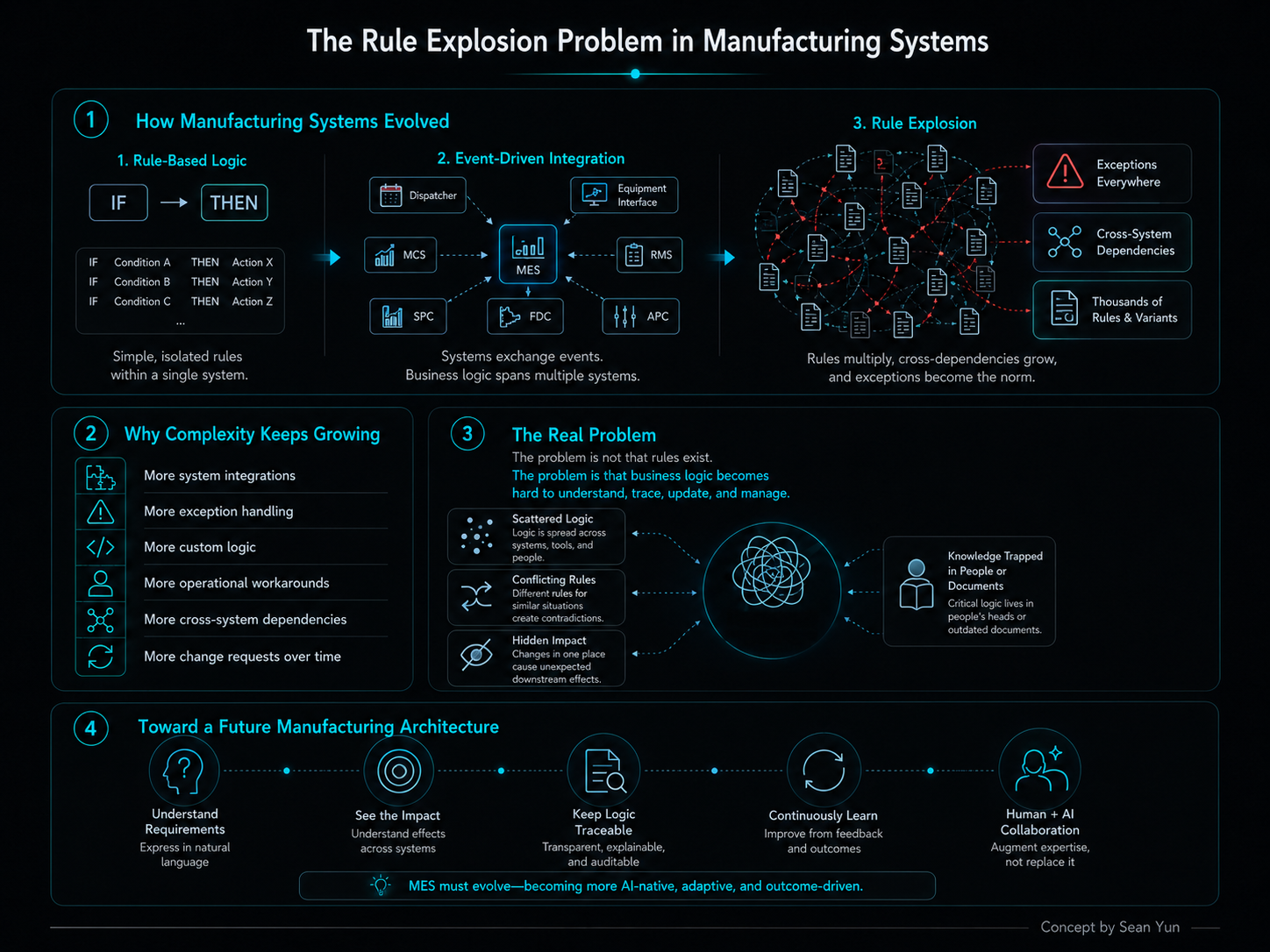
How It Started
Manufacturing systems have long been built on rule-based logic. For decades, that approach was remarkably effective.
When a condition is met, the system executes a predefined action. IF something happens, THEN the next step is triggered.
This simple model scaled surprisingly far on the factory floor.
The Architecture That Grew Around It
But manufacturing didn't stay simple. As complexity grew, responsibilities were split across specialized applications, connected through event-driven scenarios.
MES, equipment interfaces, dispatchers, MCS, RMS, SPC, FDC, APC, ERP, PLM — each system owned a piece of the operation. They exchanged events to coordinate decisions and actions end-to-end.
Those events weren't just data transfers — they became executable operating scenarios spanning multiple systems.
Event-driven architecture was a major step forward. It improved flexibility and scale, and helped teams handle richer operational logic.
Then the Problem Emerges
Yet another problem emerges over time.
Operations keep getting more complex. Logic that started as a single condition slowly accumulates exceptions:
- Equipment states
- Product types
- Process conditions
- Quality signals
- Temporary operational decisions
- Customer priorities
Over time, the system turns into a dense mesh of rules and business logic.
I call this the "rule explosion" problem.
The Rules Won't Stop
Here's the key point: future manufacturing systems can't simply "remove rules."
Rules will keep being added. New operational requirements will emerge. Requests to improve quality and productivity won't stop.
Small changes will be needed to reflect new process conditions, equipment behaviors, and operational realities.
And these requirements rarely arrive in isolation. One change can conflict with another process, equipment constraint, or product rule. What looks small at first may ripple across multiple systems, functions, and scenarios — and sometimes ultimately demand an architectural upgrade.
So the issue isn't that rules increase. The issue is how we manage, explain, and evolve them.
Who Can Actually Read the Logic?
Business logic shouldn't become something only AI can decipher. People need to understand it too.
Operators, engineers, developers, quality teams, and leadership should be able to answer:
- Why does this logic exist?
- What requirement created it?
- What does it affect — process, equipment, product?
- What exception does it handle?
- What risk appears when we change it?
That knowledge can't live only in someone's memory — or in scattered documents.
The logic implemented in the system should be managed as a first-class asset:
- Traceable
- Understandable
- Continuously updated
What the Future Looks Like
I don't think the future is about adding more rules — or making event scenarios even more complex.
Future systems should:
- Understand requirements
- Analyze impact on existing logic
- Propose the minimal effective change
- Safely support development, testing, validation, and deployment
So the real question isn't whether rules exist. The real questions are:
- How well can the system understand changing requirements?
- How accurately can it map new requirements to existing business logic?
- How effectively can it manage that knowledge in a way both humans and AI can use?
- How safely can it turn that understanding into system improvement?
Why This Points to AI-Native Architecture
This is one reason I'm interested in AI-native Manufacturing Architecture.
An AI-native system isn't just one where AI generates answers. It's an operating architecture that continuously captures and updates:
- Requirements
- Business logic
- Event scenarios
- Impact analysis
- Change history
- Validation results
- Deployment records
The goal isn't AI that writes rules for you. It's a system where rules remain understandable, traceable, and evolvable — by humans and AI working together.
This is Part 3 of the AI-Native Manufacturing Architecture Series — a 12-part exploration of how manufacturing systems need to fundamentally change.