Why Manufacturing Systems Are Becoming Harder to Maintain
Not because engineers are less capable. Not because factories lack automation. But because manufacturing complexity is growing faster than the system architectures we've built can absorb.
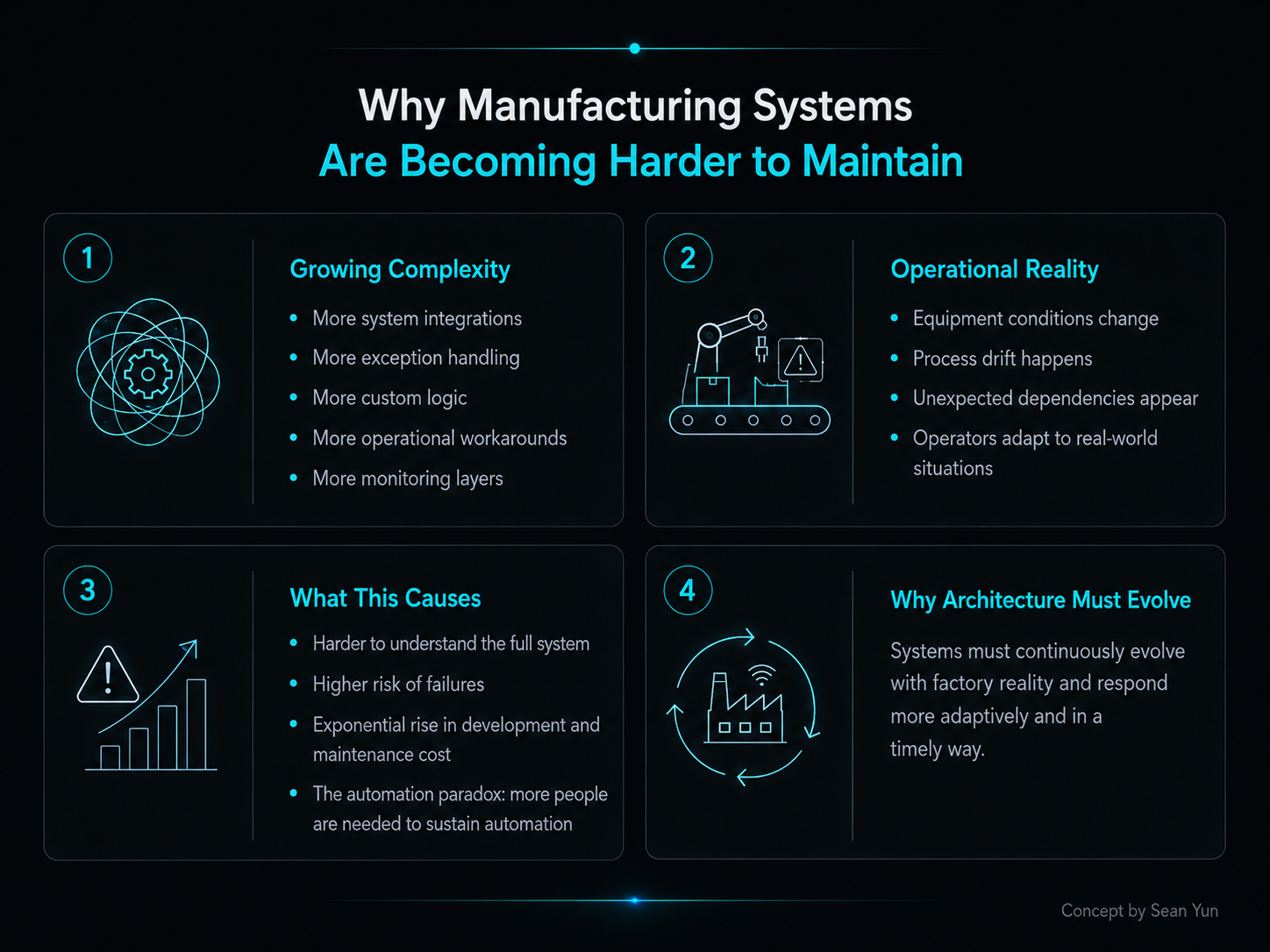
How Systems Accumulate Complexity
In my experience, manufacturing systems tend to evolve by continuously adding:
- More integrations
- More exception handling
- More custom logic
- More operational workarounds
- More monitoring layers
Each addition makes sense in isolation. Together, they compound.
In reality, manufacturing operations are far less deterministic than system diagrams suggest:
- Equipment conditions continuously change
- Process drift happens
- Unexpected dependencies emerge
- Operators constantly adapt to real-world situations
These temporary operational decisions accumulate over time.
Result: complex systems become increasingly difficult to understand, develop, and maintain — and the likelihood of failures rises.
As complexity grows, development and maintenance costs can increase exponentially.
The Paradox of Automation
Here's the paradox:
To keep "lights-out" automation running, companies often end up needing more engineers and operational staff — not fewer.
I've also seen leaders underestimate the structural complexity and day-to-day operational reality behind these systems.
Systems Are Living Organisms
They can't be built once and left unchanged — they must evolve with the realities of the manufacturing floor.
To hit productivity and quality goals in fast-moving environments, systems need to sense change and respond efficiently, at the right time.
Why the AI Era Matters
It gives us an opportunity to fundamentally rethink traditional manufacturing system architectures — not just automate workflows, but adapt to context.
- Understand context
- Make decisions autonomously (within guardrails)
- Connect decisions to actions
Looking further ahead, future systems may handle parts of their own operational lifecycle, such as:
- Detecting improvement opportunities
- Anticipating failure scenarios
- Generating or updating logic/configuration
- Testing changes safely
- Deploying with controls
- Evaluating operational impact
- Continuously correcting and refining
I've been thinking deeply about this while working across semiconductor manufacturing and factory automation environments.
This is Part 1 of the AI-Native Manufacturing Architecture Series — a 12-part exploration of how manufacturing systems need to fundamentally change.